


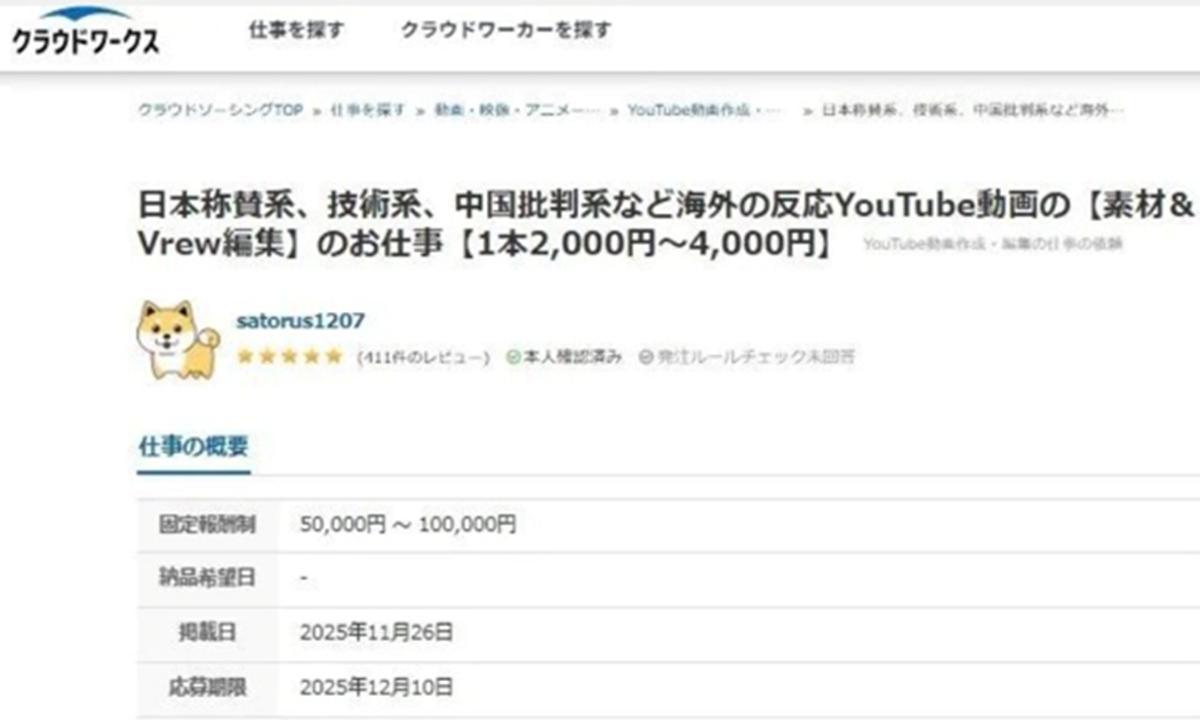
Screenshot of the recruitment post released on Nov 26, 2025.
Japanese media recently reported that CrowdWorks, a major freelance recruitment platform, had hosted postings explicitly calling for the production of videos that "praise Japan" while "criticizing China".
The reports triggered a sharp backlash from the public, with many Japanese netizens asking where the funding for the productions was coming from, as well as describing the content as humiliating and demanding a thorough investigation.
According to The Asahi Shimbun, the postings sought creators to script and edit YouTube videos — often using AI-generated images — that carried "Japan-praise" and "China-criticism". Some listings went further, urging fabricated narratives that portrayed fictional Chinese characters as immoral and disorderly. Between November last year and last month, a single recruiter posted at least 14 of the advertisements, contracting 31 contributors in the process.
After public scrutiny intensified, CrowdWorks removed the postings, citing violations of company policy. The platform also acknowledged that its AI moderation system had failed to flag the content, allowing the listings to circulate unchecked.
What unsettled people in Japan most, however, was not merely the content itself but the unanswered question of who financed it. Online commentators warned that paying freelancers to shape political narratives risks distorting public understanding, while some argued that using money as an incentive to manufacture favorable or hostile images of other countries reflects insecurity rather than confidence.
These concerns were amplified by broader scrutiny of publicity spending by political groups in Japan. On Nov 28, Mainichi Shimbun reported that groups linked to Prime Minister Sanae Takaichi had spent more than 80 million yen ($514,000) on publicity during the 2024 Liberal Democratic Party leadership race, with a large share directed toward online promotion and video production.
Compared with Takaichi's 2021 campaign, the increase marked a clear shift toward heavier reliance on media-driven messaging.
Although no direct link has been established between the CrowdWorks postings and government or party funding, the overlap has deepened public unease. For many people in Japan, the episode has raised a fundamental question: if political influence is increasingly pursued through opaque publicity campaigns and outsourced online content, how much trust can citizens place in those in power?

陜西互聯(lián)網(wǎng)違法和不良信息舉報電話:029-63907152 舉報郵箱:shxiwxb@126.com 陜西輿論環(huán)境違規(guī)線索舉報:029-82243110
互聯(lián)網(wǎng)新聞信息許可證:61120180003 陜ICP備05001925號-1  陜公網(wǎng)安備 61010302000964號
新聞熱線:029-82244483 郵箱:sanqincom@163.com 地址:陜西省西安市環(huán)城南路東段1號


 首頁
首頁